How Much Do Custom Roman Shades Cost in Denver? 2026 Pricing Guide
What custom Roman shades cost in Denver in 2026, what drives the price per window, and how fabric, lining, size, and motorization change your quote.
Updated September 14, 2026
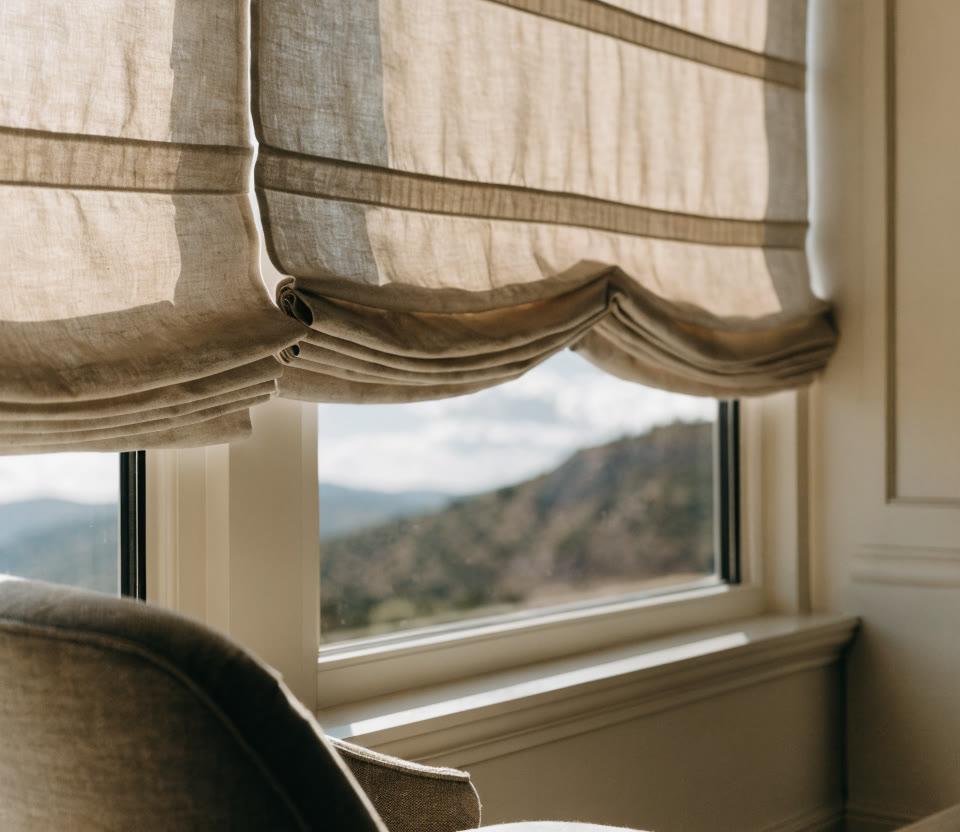
Most custom Roman shade projects in Denver start around $300 to $700 per window installed. That range covers a professionally measured, fabricated, and installed shade in a quality fabric with a standard lining. Designer textiles, blackout linings, oversized windows, and motorization move the investment upward from there.
Because every Roman shade we build is cut and sewn for a specific window, no two quotes are identical. This guide explains exactly what drives the price so you can plan your budget with real expectations before your consultation.
How much do custom Roman shades cost in Denver?
The $300 to $700 per window starting range reflects a typical Denver project: a standard-sized window, a mid-weight designer fabric, a privacy lining, and professional installation. Smaller bathroom and kitchen windows often land at the lower end. Large living room windows, premium fabrics, and upgraded linings push toward and beyond the upper end.
Ready-made Roman shades from big-box stores cost less upfront, but they come in fixed sizes and a narrow fabric selection, and they are not built for your window. A custom shade fits the opening exactly, stacks evenly, and is fabricated to handle daily use for years. The price difference buys fit, fabric choice, and durability.
What drives the price of a Roman shade?
Five factors determine where your project lands within and beyond the starting range.
Fabric tier. Fabric is the largest cost variable. A quality mid-weight linen blend sits at one price point; a designer textile from a couture fabric house can double or triple the material cost. Because a Roman shade is essentially a tailored fabric panel, the textile you fall in love with shapes the quote more than anything else.
Window size and quantity. Wider and taller windows require more fabric and more robust lift hardware. At the same time, multi-window projects are more efficient per window than a single shade, so whole-room projects often price better than one-off windows.
Lining. A standard privacy lining is typically included in the base price. Thermal and blackout linings add material and labor, and in Denver's intense high-altitude sun they are usually worth it for the UV protection alone.
Fold style and detailing. A simple flat fold is the most economical construction. Soft fold and relaxed styles use more fabric, and decorative details like contrast banding, trims, and coordinated valances add to the workroom time.
Motorization. A motorized lift system is a meaningful upgrade per window, covering the motor, power source, and smart home integration. It is most cost-effective when several shades are motorized together on one project.
How does fabric choice affect cost?
Roman shades use drapery-weight fabric, and the workroom needs enough yardage for the full drop of the shade plus the fold allowance. On a tall window, that can mean several yards of your chosen textile. This is why two shades of identical size can price very differently: the construction labor is similar, but the fabric cost is not.
Our guidance during consultations is to invest in fabric where the shade is the star of the room, such as a dining room or primary bedroom, and to choose durable, fade-resistant mid-tier fabrics for high-sun utility spaces. If you are still deciding on fold style and fabric family, our complete Denver Roman shade guide covers those decisions in depth.
Does motorization add much to the price?
Motorization adds a per-window cost for the motor and power, plus setup for remotes or smart home scenes. Battery-powered motors avoid any electrical work and keep the upgrade simpler. Hardwired systems make sense during a renovation when walls are open. Clients consistently tell us motorization is the upgrade they appreciate most daily, especially on tall windows and in rooms where shades move on a schedule.
Are custom Roman shades worth the investment?
For most Denver homeowners, yes, and for three reasons. First, fit: a shade built for your window operates smoothly and looks intentional in a way a near-miss ready-made never does. Second, longevity: quality workroom construction and a proper lining protect your fabric investment from Colorado's UV for years. Third, design value: Roman shades read as a finished, furnished interior, and they pair naturally with drapery for a layered look that elevates the whole room.
If you are weighing Romans against a more minimal option, our Roman vs roller shade comparison includes a cost discussion alongside style and performance trade-offs.
How do you get an exact quote?
Every Blinds Couture project starts with a complimentary in-home consultation anywhere in the Denver metro. We measure each window precisely, bring the fabric library to your home, and provide a written all-in quote that covers fabrication and installation with no hidden fees. There is no obligation, and you will know your exact number before any work begins.
You can also browse our custom Roman shades in Denver page to see styles and start planning. When you are ready, we will bring the samples to you.
Serving Denver since 1999
Blinds Couture Showroom
590 Quivas St
Denver, CO 80204
(720) 729-0091
Blinds Couture
Denver's premier custom window treatment studio
With over 25 years serving Colorado homeowners and designers, Blinds Couture brings expert knowledge in custom drapery, blinds, shades, shutters, and motorized window treatments. Our team combines design expertise with hands-on craftsmanship to create beautiful, functional spaces.
Learn more about our team